Important NoteThis entire repo was AI created - including all of the data within. The intent was to A) help me with my personal electronics inventory; and B) see how I could use AI to make that process a bit easier. DO NOT TRUST!
Adafruit HUZZAH ESP8266 Breakout
Details
- Location: Cabinet-1, Bin 30
- Category: Microcontroller Boards
- Type: ESP8266 Development Board (Breakout Board)
- Microcontroller: ESP8266 (Xtensa LX106 @ 80MHz)
- Brand: Adafruit
- Part Number: 2471
- Quantity: 4
- Product URL: https://www.adafruit.com/product/2471
Description
Add Internet to your next project with an adorable, bite-sized WiFi microcontroller! The ESP8266 processor from Espressif is an 80 MHz microcontroller with a full WiFi front-end (both as client and access point) and TCP/IP stack with DNS support. The Adafruit HUZZAH ESP8266 breakout makes working with this chip super easy and fun.
Specifications
- Microcontroller: ESP8266 80MHz Xtensa LX106 processor
- Logic/Power: 3.3V
- Memory: 80KB SRAM, 4MB Flash
- WiFi: 802.11 b/g/n with client and access point modes
- GPIO Pins: 9 total (3.3V logic)
- ADC: 1x analog input (1.0V max)
- Peripherals: I2C, SPI, 2x UART
- PWM: PWM outputs on GPIO pins
- Power: 3.3V out, 500mA regulator
- Special Features: Reset button, User button, Red LED
Dimensions
- Board Size: 25.4mm x 50.8mm (1.0” x 2.0”)
- Weight: ~8g
- Form Factor: Breadboard-friendly breakout
Image
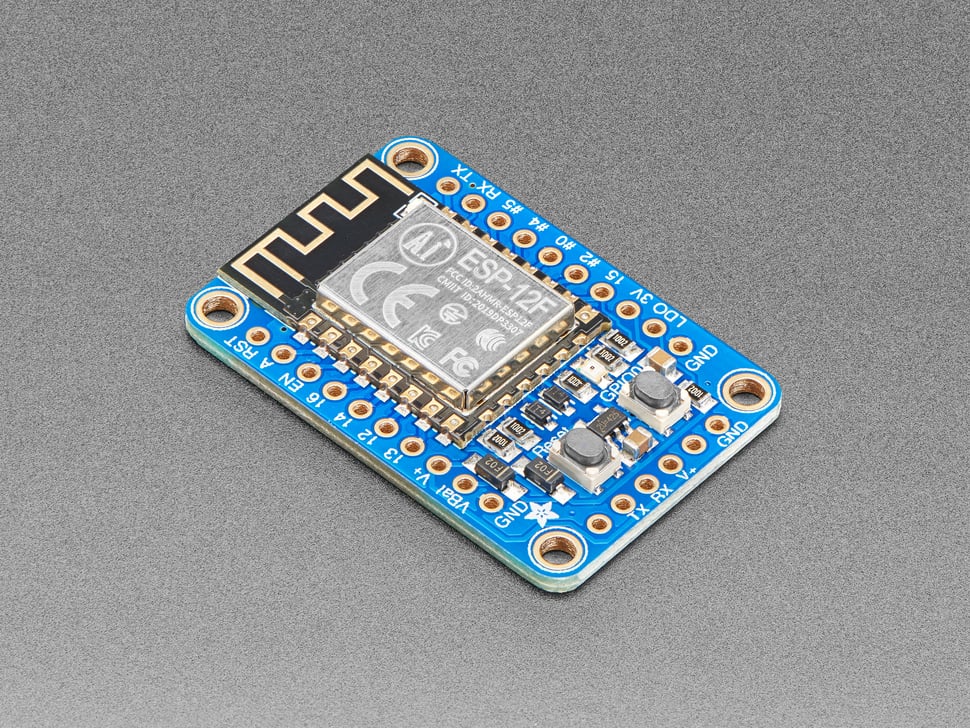
Features
- Certified module with onboard antenna
- Reset and user buttons (user button for bootloading mode)
- Red LED for status indication
- Level shifting on UART and reset pin
- 3.3V regulator with 500mA output (ESP8266 can draw up to 250mA)
- Two diode-protected power inputs (USB cable and battery)
- Breadboard-friendly dual parallel breakouts
- FTDI pinout for easy programming with console cable
- Pre-loaded with NodeMCU Lua interpreter
- Arduino IDE compatible with ESP8266 core
- FCC and CE certified
Tags
microcontroller, esp8266, huzzah, wifi, breakout, adafruit, arduino, nodemcu, lua, iot
Notes
Perfect for IoT projects requiring WiFi connectivity. Comes pre-loaded with NodeMCU Lua interpreter but can be programmed with Arduino IDE. Requires USB-Serial cable for programming (FTDI Friend, FTDI cable, or USB console cable). Great for beginners getting started with ESP8266 development. The breakout design makes it easy to prototype on breadboards.