Important NoteThis entire repo was AI created - including all of the data within. The intent was to A) help me with my personal electronics inventory; and B) see how I could use AI to make that process a bit easier. DO NOT TRUST!
Adafruit QT Py ESP32 Pico - WiFi Dev Board with STEMMA QT
Details
- Location: Cabinet-1, Bin 26
- Category: Microcontroller Boards
- Type: WiFi & Bluetooth Development Board with STEMMA QT
- Microcontroller: ESP32-PICO-V3-02
- Brand: Adafruit
- Part Number: 5395
- Quantity: 1
- Product URL: https://www.adafruit.com/product/5395
Description
The super-hero QT Py board featuring the ESP32 Pico V3 02! This thumbnail-sized PCB features an all-in-one ESP32 chip with dual-core 240MHz Tensilica processor, WiFi, Bluetooth Classic + BLE, 8MB Flash, and 2MB PSRAM. Compatible with Seeed Xiao form factor with castellated pads for direct PCB mounting.
Specifications
- Part Number: 5395
- Microcontroller: ESP32-PICO-V3-02 (all-in-one package)
- Architecture: Xtensa LX6 32-bit dual-core
- Clock Speed: 240MHz
- Operating Voltage: 3.3V
- Flash Memory: 8MB
- PSRAM: 2MB
- Dimensions: 22.0mm x 17.9mm x 5.9mm
- Weight: 2.3g
Image
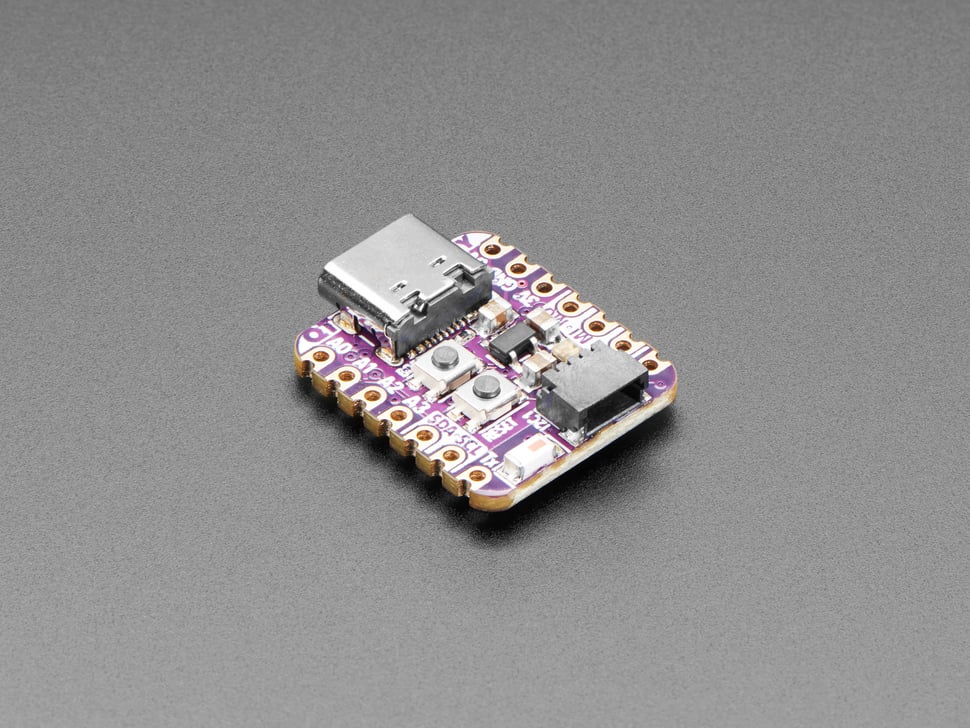
Features
- Dual-Core ESP32: 240MHz Tensilica processor with dual cores
- Wireless Connectivity: WiFi 802.11 b/g/n + Bluetooth Classic + BLE
- All-in-One Package: ESP32-PICO-V3-02 integrates everything in one chip
- STEMMA QT Connector: Plug-and-play I2C sensor connectivity
- USB-C Connector: Modern connector for programming and power
- RGB NeoPixel: Built-in addressable LED with power control
- Xiao Compatible: Same pinout and form factor as Seeed Xiao
- Castellated Pads: Can be soldered directly to PCB
- Reset & Boot Buttons: Easy programming and debugging
Pin Configuration
- Digital I/O: 13 GPIO pins (11 on breakout, 2 on QT connector)
- Analog Inputs: 10 pins (12-bit ADC)
- Analog Outputs: 2 pins (dual 8-bit DACs on A0/A1)
- PWM: Available on any pin
- I2C: Two ports (breakout pads + STEMMA QT)
- SPI: Hardware SPI on high-speed peripheral pins
- UART: Hardware UART in addition to USB-serial
- I2S: Hardware I2S on any pins
- Capacitive Touch: 8 pins with no additional components
Power Specifications
- Operating Voltage: 3.3V
- Input Voltage: 5V (USB-C) or up to 6V (battery pads)
- Regulator: 3.3V with 600mA peak output
- Current Consumption:
- Light sleep: ~4mA
- Deep sleep: ~70µA
- Battery Support: Underside pads with diode protection
Wireless Capabilities
WiFi
- Standards: 802.11 b/g/n (2.4GHz)
- Modes: Station, Access Point, Station+AP
- Security: WEP, WPA, WPA2, WPA3
- Range: Typical indoor WiFi range
Bluetooth
- Classic Bluetooth: Full Bluetooth support
- Bluetooth Low Energy (BLE): Ultra-low power wireless
- Protocols: SPP, HID, A2DP, and more
- Range: Up to 10m (Class 2)
Applications
- IoT sensor nodes with WiFi and Bluetooth connectivity
- Wireless sensor networks
- Smart home controllers
- Bluetooth audio projects
- STEMMA QT sensor networks
- Arduino WiFi/Bluetooth projects
- Portable data loggers
- Dual-wireless communication hubs
Programming
- Arduino IDE: Full support with ESP32 board package
- ESP-IDF: Espressif development framework
- MicroPython: Native support
- USB Programming: No external programmer needed (USB-to-serial converter)
- Libraries: WiFi, Bluetooth, HTTP, MQTT, sensor libraries
STEMMA QT Ecosystem
- Plug-and-Play: No soldering required for I2C sensors
- Chainable: Multiple sensors can be daisy-chained
- Compatible: Works with SparkFun Qwiic and Seeed Grove I2C
- Extensive: Large ecosystem of compatible sensors and displays
Advantages
- Dual-Core Performance: More processing power than single-core variants
- Dual Wireless: Both WiFi and Bluetooth in one tiny package
- All-in-One Chip: ESP32-PICO-V3-02 integrates everything seamlessly
- Compact Size: Tiny form factor for space-constrained projects
- Easy Connectivity: STEMMA QT eliminates wiring complexity
- Rich I/O: Dual DACs and extensive GPIO options
- Low Power: Excellent for battery-powered applications
Hardware Notes
- USB-to-Serial: Uses CH9102F converter (not native USB like ESP32-S2)
- Cannot act as USB HID: No native USB support (use Bluetooth instead)
- Regulator: May use different regulator than AP2112K due to supply chain
- Driver: Windows/Mac drivers available for CH9102F
Comparison with Other QT Py Boards
- vs ESP32-S2: Dual-core + Bluetooth vs single-core + native USB
- vs ESP32-C3: Dual-core Xtensa vs single-core RISC-V
- vs XIAO ESP32C3: More flash/PSRAM, dual-core, but larger size
Notes
- Dual-core ESP32 provides more processing power than single-core variants
- Bluetooth Classic + BLE enables rich wireless communication options
- ESP32-PICO-V3-02 is an all-in-one solution with integrated components
- 8MB Flash + 2MB PSRAM allows for complex applications
- Perfect for projects requiring both WiFi and Bluetooth connectivity
- STEMMA QT connector makes sensor integration effortless
- Compatible with Xiao ecosystem accessories
Tags
microcontroller, esp32-pico, wifi, bluetooth, qt-py, stemma-qt, usb-c, adafruit, iot, dual-core