Important NoteThis entire repo was AI created - including all of the data within. The intent was to A) help me with my personal electronics inventory; and B) see how I could use AI to make that process a bit easier. DO NOT TRUST!
Adafruit QT Py ESP32-S2 WiFi Dev Board with STEMMA QT
Details
- Location: Cabinet-1, Bin 26
- Category: Microcontroller Boards
- Type: WiFi Development Board with STEMMA QT
- Microcontroller: ESP32-S2
- Brand: Adafruit
- Part Number: 5325
- Quantity: 10
- Product URL: https://www.adafruit.com/product/5325
Description
The cutest ESP32-S2 development board! This diminutive dev board features the ESP32-S2 with built-in native USB, WiFi connectivity, and STEMMA QT connector for easy sensor integration. Compatible with Seeed Xiao form factor with castellated pads for direct PCB mounting.
Specifications
- Part Number: 5325
- Microcontroller: ESP32-S2 (single-core)
- Architecture: Xtensa LX7 32-bit
- Clock Speed: 240MHz
- Operating Voltage: 3.3V
- Flash Memory: 4MB
- PSRAM: 2MB
- Dimensions: 21.8mm x 17.9mm x 5.7mm
- Weight: 2.1g
Image
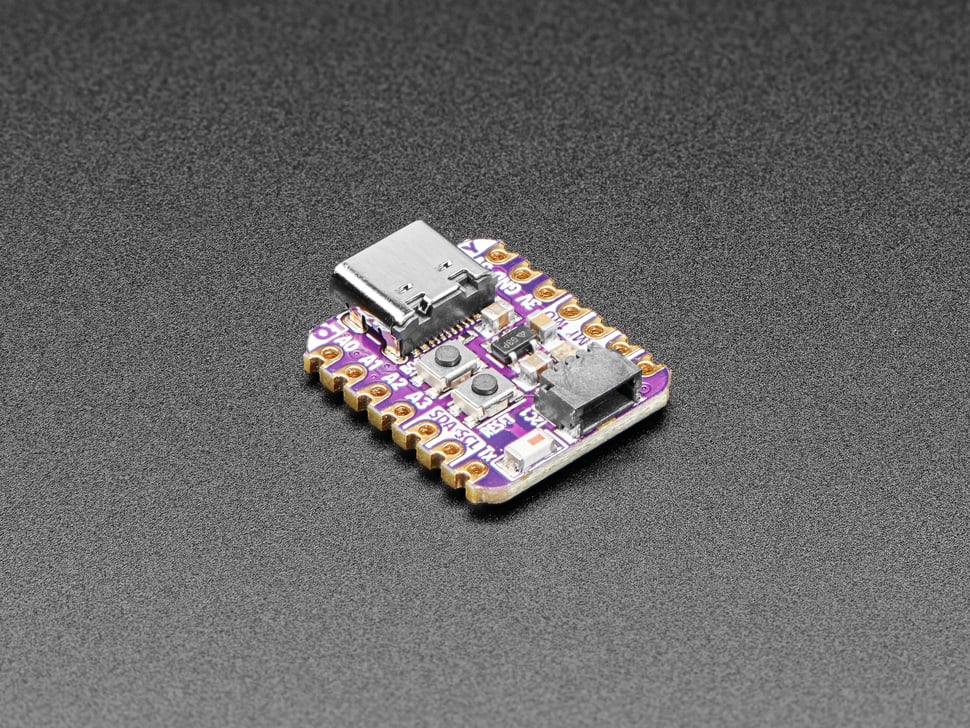
Features
- Native USB: Built-in USB support - can act as keyboard/mouse, MIDI device, disk drive
- WiFi Connectivity: 2.4 GHz Wi-Fi 802.11 b/g/n
- STEMMA QT Connector: Plug-and-play I2C sensor connectivity
- USB-C Connector: Modern connector for programming and power
- RGB NeoPixel: Built-in addressable LED with power control
- Xiao Compatible: Same pinout and form factor as Seeed Xiao
- Castellated Pads: Can be soldered directly to PCB
- Reset & Boot Buttons: Easy programming and debugging
Pin Configuration
- Digital I/O: 13 GPIO pins (11 on breakout, 2 on QT connector)
- Analog Inputs: 10 pins (12-bit ADC)
- Analog Output: 1 pin (8-bit DAC)
- PWM: Available on any pin
- I2C: Two ports (breakout pads + STEMMA QT)
- SPI: Hardware SPI on high-speed peripheral pins
- UART: Hardware UART
- I2S: Hardware I2S on any pins
- Capacitive Touch: 5 pins with no additional components
Power Specifications
- Operating Voltage: 3.3V
- Input Voltage: 5V (USB-C) or up to 6V (battery pads)
- Regulator: 3.3V with 600mA peak output
- Current Consumption:
- Light sleep: 2-4mA
- Deep sleep: ~70µA (hardware rev C)
- Battery Support: Underside pads with diode protection
Applications
- IoT sensor nodes with WiFi connectivity
- USB HID devices (keyboard, mouse, MIDI)
- Wearable electronics projects
- STEMMA QT sensor networks
- CircuitPython projects
- Arduino WiFi projects
- Portable data loggers
- Smart home controllers
Programming
- Arduino IDE: Full support with ESP32 board package
- CircuitPython: Native support with USB drive functionality
- ESP-IDF: Espressif development framework
- USB Programming: No external programmer needed
- Libraries: WiFi, HTTP, MQTT, sensor libraries
STEMMA QT Ecosystem
- Plug-and-Play: No soldering required for I2C sensors
- Chainable: Multiple sensors can be daisy-chained
- Compatible: Works with SparkFun Qwiic and Seeed Grove I2C
- Extensive: Large ecosystem of compatible sensors and displays
Advantages
- Native USB: Advanced USB functionality built-in
- Compact Size: Tiny form factor for space-constrained projects
- Easy Connectivity: STEMMA QT eliminates wiring complexity
- Dual Programming: Arduino IDE and CircuitPython support
- Low Power: Excellent for battery-powered applications
- WiFi Built-in: No additional modules needed for connectivity
Hardware Revisions
- Rev B (before Feb 28, 2022): Deep sleep draws ~6mA (hardware bug)
- Rev C (after Feb 28, 2022): Fixed deep sleep (~70µA), improved antenna
Notes
- Single-core ESP32-S2 (not dual-core like ESP32)
- No Bluetooth support (WiFi only)
- Native USB unlocks advanced interfacing capabilities
- 4MB Flash + 2MB PSRAM allows for complex applications
- Perfect for IoT projects requiring WiFi connectivity
- STEMMA QT connector makes sensor integration effortless
- Compatible with Xiao ecosystem accessories
Tags
microcontroller, esp32-s2, wifi, qt-py, stemma-qt, usb-c, adafruit, iot, circuitpython