Important NoteThis entire repo was AI created - including all of the data within. The intent was to A) help me with my personal electronics inventory; and B) see how I could use AI to make that process a bit easier. DO NOT TRUST!
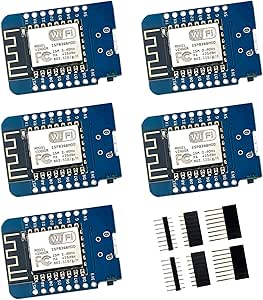
D1 Mini NodeMCU ESP8266 ESP-12F WiFi Module Development Board
Details
- Location: Cabinet-1, Bin 25
- Category: Microcontroller Boards
- Type: WiFi Development Board
- Microcontroller: ESP8266 ESP-12F
- Brand: Hosyond
- Model: D1 Mini
- Quantity: 6
- Product URL: https://a.co/d/9RKNNKX
Description
Compact WiFi-enabled microcontroller development board based on the ESP8266 ESP-12F chip. Compatible with Arduino IDE and WeMos D1 Mini ecosystem. Perfect for IoT projects requiring WiFi connectivity in a small form factor. Features built-in USB programming interface and comprehensive GPIO support.
Specifications
- Microcontroller: ESP8266 ESP-12F
- Architecture: Xtensa LX106 32-bit
- Clock Speed: 80MHz (up to 160MHz)
- Operating Voltage: 3.3V
- Input Voltage: 5V (via USB) or 3.3V
- Flash Memory: 4MB
- RAM: 1MB (512KB available for user)
- WiFi: 802.11 b/g/n 2.4GHz
- Dimensions: 34.2mm x 25.6mm x 7.6mm
- Weight: ~3g
Image
Features
- WiFi Connectivity: Built-in 802.11 b/g/n WiFi
- Arduino Compatible: Program with Arduino IDE
- Compact Design: Mini form factor for space-constrained projects
- USB Programming: Micro USB for power and programming
- Rich I/O: 11 digital pins with interrupt/PWM/I2C/1-wire support
- Analog Input: 1 analog input (3.2V max)
- Power Management: 5V switching power supply onboard
- Reset Protection: 500mA resettable fuse
Pin Configuration
- Digital I/O: 11 pins (D0-D10)
- Analog Input: 1 pin (A0, 3.2V max)
- PWM: All digital pins except D0
- I2C: SDA (D2), SCL (D1)
- SPI: MOSI (D7), MISO (D6), SCK (D5)
- UART: TX (D1), RX (D3)
- Special: D0 (no interrupt/PWM/I2C support)
Power Specifications
- Operating Voltage: 3.3V
- Input Voltage: 5V (USB) or 3.3V (VCC pin)
- Current: ~80mA active, ~20µA deep sleep
- Power Supply: Built-in 5V to 3.3V regulator
- Protection: 500mA resettable fuse
Applications
- IoT sensor nodes
- Home automation controllers
- WiFi-enabled projects
- Remote monitoring systems
- Smart switches and relays
- Environmental sensors
- Web servers and clients
- MQTT clients
Programming
- Arduino IDE: Full support with ESP8266 board package
- MicroPython: Native support
- NodeMCU Lua: Original firmware support
- PlatformIO: Professional development environment
- Libraries: Extensive WiFi, HTTP, MQTT libraries
Compatibility
- WeMos D1 Mini: Pin-compatible
- Arduino Shields: Many shields compatible
- Breadboard: Fits standard breadboards
- Prototyping: Easy to integrate into projects
WiFi Capabilities
- Standards: 802.11 b/g/n
- Frequency: 2.4GHz
- Modes: Station, Access Point, Station+AP
- Security: WEP, WPA, WPA2
- Range: Typical indoor WiFi range
- Protocols: TCP/IP, HTTP, HTTPS, MQTT, WebSocket
Development Features
- USB Programming: No external programmer needed
- Serial Monitor: Built-in USB-to-serial
- OTA Updates: Over-the-air firmware updates
- File System: SPIFFS for file storage
- Web Server: Can host simple web interfaces
Notes
- Compatible with Arduino IDE and WeMos D1 Mini libraries
- Excellent for beginners and professionals alike
- Large community support and documentation
- Perfect balance of features, size, and cost
- Ideal for rapid prototyping of WiFi projects
- Can be powered via USB or external 3.3V/5V supply
Tags
microcontroller, esp8266, wifi, d1-mini, nodemcu, arduino-compatible, iot, wireless