Important NoteThis entire repo was AI created - including all of the data within. The intent was to A) help me with my personal electronics inventory; and B) see how I could use AI to make that process a bit easier. DO NOT TRUST!
LM741 - General-Purpose Operational Amplifier
Details
- Location: Cabinet-3, Bin 37, Section A
- Category: Analog ICs
- Brand: Various (TI, STMicroelectronics, etc.)
- Part Number: LM741 / LM741CN
- Package: 8-DIP
- Quantity: 16
- Status: Available
- Price Range: $0.50-1.50
- Datasheet: LM741 Datasheet
- Product URL: https://www.ti.com/product/LM741
Description
The LM741 is a classic and widely-used general-purpose operational amplifier that has been a staple in analog circuit design for decades. It features internal frequency compensation, short-circuit protection, and offset voltage null capability. While not the fastest or most precise op-amp by modern standards, it remains popular for educational purposes and general analog applications where moderate performance is sufficient.
Specifications
Electrical Characteristics
- Operating Voltage: ±3V ~ ±18V (±15V typical)
- Supply Current: 1.7mA (typical)
- Input Offset Voltage: 1mV (typical)
- Input Bias Current: 80nA (typical)
- Slew Rate: 0.5V/µs
- Gain Bandwidth Product: 1MHz
- Open Loop Gain: 200,000 (106dB)
- Output Current: ±25mA
Physical Characteristics
- Package: 8-DIP (0.300”, 7.62mm)
- Dimensions: Standard 8-pin DIP package
- Operating Temperature: 0°C ~ 70°C (commercial), -55°C ~ 125°C (military)
- Mounting Type: Through Hole
Key Features
- Internal frequency compensation for stability
- Short-circuit protection on outputs
- Offset voltage null capability (pins 1 & 5)
- No latch-up when common mode range is exceeded
- Wide supply voltage range
- Industry standard pinout
- Proven reliability and availability
Pinout Diagram
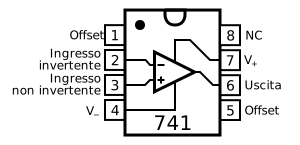
Pinout diagram: LM741 operational amplifier in DIP package (Creative Commons CC0, Wikimedia Commons)
Pin Descriptions (8-DIP Package)
| Pin | Name | Function |
|---|---|---|
| 1 | OFFSET N1 | Offset null (optional) |
| 2 | IN- | Inverting input |
| 3 | IN+ | Non-inverting input |
| 4 | V- | Negative power supply |
| 5 | OFFSET N2 | Offset null (optional) |
| 6 | OUTPUT | Op-amp output |
| 7 | V+ | Positive power supply |
| 8 | NC | Not connected |
Applications
Common use cases and applications for this component:
- Basic amplifier circuits
- Active filters (low-pass, high-pass, band-pass)
- Voltage followers and buffers
- Comparators (with external feedback)
- Integrators and differentiators
- Instrumentation circuits
- Educational and learning projects
- Audio preamplifiers (low-frequency)
- DC amplification applications
Circuit Examples
Basic Non-Inverting Amplifier
V+ (Pin 7) ---- +15V
V- (Pin 4) ---- -15V
IN+ (Pin 3) ---- Input signal
IN- (Pin 2) ---- Feedback from output through voltage divider
OUTPUT (Pin 6) ---- Amplified output

Gain = 1 + (R2/R1) where R2 is feedback resistor, R1 is ground resistor
Voltage Follower (Unity Gain Buffer)
V+ (Pin 7) ---- +15V
V- (Pin 4) ---- -15V
IN+ (Pin 3) ---- Input signal
IN- (Pin 2) ---- Connected directly to OUTPUT (Pin 6)
OUTPUT (Pin 6) ---- Buffered output (same voltage as input)
Active Low-Pass Filter
Input signal -> R1 -> IN+ (Pin 3)
IN- (Pin 2) connected to output through feedback network
C1 from IN+ to ground for frequency response
OUTPUT (Pin 6) -> Filtered output
Cutoff frequency = 1/(2π × R1 × C1)
Technical Notes
Important technical considerations and features:
- Slew Rate Limitation: 0.5V/µs limits high-frequency performance
- Offset Nulling: Use 10kΩ potentiometer between pins 1 and 5, wiper to V-
- Power Supply Decoupling: Use 0.1µF ceramic capacitors close to power pins
- Input Protection: Avoid input voltages exceeding supply rails
- Frequency Compensation: Internally compensated, stable for unity gain
- Output Drive: Can source/sink ±25mA, suitable for moderate loads
- Common Mode Range: Typically within 2V of supply rails
- Single Supply Operation: Possible with proper biasing (Vcc/2 reference)
Historical Significance
The LM741 was introduced in the late 1960s and became the industry standard operational amplifier. It was one of the first op-amps to include internal frequency compensation, making it much easier to use than earlier designs like the LM709. Despite being superseded by newer designs in many applications, it remains widely used for education and general-purpose analog circuits.
Modern Alternatives
For new designs, consider these improved alternatives:
- TL071/TL081: JFET input, higher speed, lower noise
- LM358: Dual op-amp, single supply operation
- OPA2134: Audio-grade, very low noise and distortion
- LMC6482: Rail-to-rail I/O, CMOS technology
Tags
op-amp, analog-ic, single-opamp, general-purpose, classic, lm741 cabinet-3 bin-37 status-available
Notes
The LM741 is often called the “grandfather of op-amps” and remains one of the most recognizable ICs in electronics. While its performance is modest by today’s standards, it’s still excellent for learning analog circuit design principles and for applications where its limitations aren’t critical. Its widespread availability, low cost, and extensive documentation make it a valuable component for educational projects and basic analog circuits. Having 16 of these provides good flexibility for various analog projects and experiments.