Important NoteThis entire repo was AI created - including all of the data within. The intent was to A) help me with my personal electronics inventory; and B) see how I could use AI to make that process a bit easier. DO NOT TRUST!
nRF24L01+ Wireless Modules Collection
Details
- Location: Cabinet-3, Bin 18
- Category: Wireless Modules
- Brand: MakerFocus
- Chip: nRF24L01+ (Nordic Semiconductor)
- Total Quantity: 16 modules
- Amazon Products: Two different variants purchased
Description
Collection of nRF24L01+ wireless transceiver modules from MakerFocus, featuring both standard and extended-range variants. These 2.4GHz ISM band transceivers are popular for Arduino and Raspberry Pi projects, offering reliable wireless communication with auto-acknowledge and auto-retransmit capabilities.
Module Variants
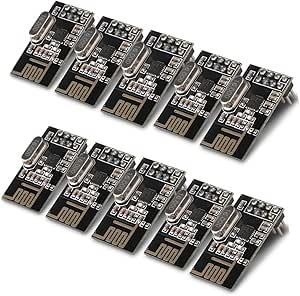
Standard nRF24L01+ Modules (10 pieces)
- Product: MakerFocus 10pcs NRF24L01+ 2.4GHz Wireless RF Transceiver Module
- Quantity: 10 modules
- Range: Standard range (up to 100m line of sight)
- Features:
- Basic nRF24L01+ chip
- Compact PCB antenna
- Low power consumption
- SPI interface
- 6 data reception channels
- Auto-acknowledge and auto-retransmit
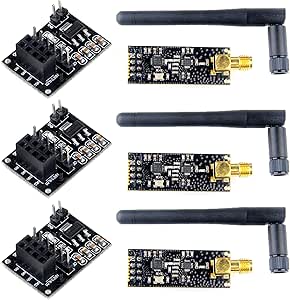
Extended Range PA+LNA Modules (6 pieces)
- Product: MakerFocus 3pcs nRF24L01+PA+LNA with Antenna + 3pcs Breakout Adapter
- Quantity: 3 PA+LNA modules + 3 breakout adapters
- Range: Extended range (up to 1100m with external antenna)
- Features:
- nRF24L01+ with Power Amplifier (PA) and Low Noise Amplifier (LNA)
- External SMA antenna connector
- 3 included 2.4GHz antennas
- 3 breakout adapters with 3.3V regulators
- Enhanced transmission power and sensitivity
Images
Technical Specifications
Core nRF24L01+ Chip
- Manufacturer: Nordic Semiconductor
- Frequency: 2.4GHz ISM band (2.400 - 2.4835 GHz)
- Data Rate: 250kbps, 1Mbps, 2Mbps
- Channels: 125 selectable channels
- Output Power: 0dBm (standard), +20dBm (PA+LNA variant)
- Sensitivity: -94dBm (standard), enhanced with LNA
- Supply Voltage: 1.9V - 3.6V
Communication Features
- Protocol: Enhanced ShockBurst™
- Auto-Acknowledgment: Automatic packet acknowledgment
- Auto-Retransmit: Configurable retransmission
- Dynamic Payload: 1-32 bytes per packet
- Multiceiver: Up to 6 data pipes
- Address Width: 3, 4, or 5 bytes
Interface Specifications
- Interface: SPI (up to 10Mbps)
- Control Pins: CE (Chip Enable), CSN (SPI Chip Select), IRQ (Interrupt)
- Power Modes: Power down, standby, RX, TX
- Current Consumption:
- TX: 11.3mA (0dBm), 115mA (PA+LNA at +20dBm)
- RX: 13.5mA (standard), enhanced with LNA
- Power Down: 900nA
Range Comparison
Standard nRF24L01+ Modules
- Indoor Range: 10-30 meters
- Outdoor Range: 50-100 meters (line of sight)
- Antenna: PCB trace antenna
- Best For: Short-range applications, low power projects
PA+LNA Extended Range Modules
- Indoor Range: 100-300 meters
- Outdoor Range: 500-1100 meters (line of sight)
- Antenna: External SMA antenna (included)
- Best For: Long-range applications, outdoor projects
Applications
Home Automation
- Sensor Networks: Temperature, humidity, motion sensors
- Remote Controls: Wireless switches and dimmers
- Security Systems: Door/window sensors, alarms
- Smart Devices: IoT device communication
Robotics Projects
- Remote Control: Robot control and telemetry
- Sensor Data: Wireless sensor feedback
- Multi-Robot: Robot-to-robot communication
- Base Station: Central control systems
Arduino/Raspberry Pi Projects
- Weather Stations: Remote sensor data collection
- RC Vehicles: Radio-controlled cars, drones
- Data Logging: Wireless data transmission
- Gaming: Wireless controllers and interfaces
Arduino Compatibility
Wiring Connections
Arduino Uno Connection
nRF24L01+      Arduino Uno
----------     -----------
VCC       →    3.3V (IMPORTANT: NOT 5V!)
GND       →    GND
CE        →    Pin 9
CSN       →    Pin 10
SCK       →    Pin 13 (SCK)
MOSI      →    Pin 11 (MOSI)
MISO      →    Pin 12 (MISO)
IRQ       →    Pin 2 (optional)

WARNING: nRF24L01+ is 3.3V only! Using 5V will damage the module.
Raspberry Pi Pico Connection
nRF24L01+      Pico
----------     ----
VCC       →    3V3
GND       →    GND
CE        →    GP15
CSN       →    GP17
SCK       →    GP18 (SPI0 SCK)
MOSI      →    GP19 (SPI0 MOSI)
MISO      →    GP16 (SPI0 MISO)
IRQ       →    GP2 (optional)
ESP32 Connection
nRF24L01+      ESP32
----------     -----
VCC       →    3.3V
GND       →    GND
CE        →    GPIO4
CSN       →    GPIO5
SCK       →    GPIO18 (SCK)
MOSI      →    GPIO23 (MOSI)
MISO      →    GPIO19 (MISO)
IRQ       →    GPIO2 (optional)
Power Supply Notes
- Critical: nRF24L01+ requires 3.3V power supply
- Current: Can draw up to 13.5mA during transmission
- Decoupling: Add 10µF and 100nF capacitors near VCC pin
- Voltage Regulator: Use dedicated 3.3V regulator for Arduino 5V boards
Required Libraries
- RF24: Primary Arduino library for nRF24L01+
- RF24Network: Mesh networking capabilities
- RF24Mesh: Dynamic mesh networking
- TMRh20/RF24: Enhanced version with additional features
Basic Code Example
#include <SPI.h>
#include <nRF24L01.h>
#include <RF24.h>

RF24 radio(9, 10); // CE, CSN pins
const byte address[6] = "00001";

void setup() {
  radio.begin();
  radio.openWritingPipe(address);
  radio.setPALevel(RF24_PA_MIN);
  radio.stopListening();
}

void loop() {
  const char text[] = "Hello World";
  radio.write(&text, sizeof(text));
  delay(1000);
}
Breakout Adapter Features (PA+LNA Kit)
3.3V Voltage Regulator
- Input: 5V from Arduino
- Output: 3.3V for nRF24L01+ module
- Current: Sufficient for PA+LNA operation
- Protection: Overcurrent and thermal protection
Additional Features
- LED Indicator: Power-on status LED
- Pin Compatibility: Standard nRF24L01+ pinout
- Mounting: Breadboard and perfboard compatible
- Size: Compact design for easy integration
Power Considerations
Standard Modules
- Arduino 3.3V: Can power directly from Arduino 3.3V pin
- Current Draw: Low current, suitable for battery operation
- Decoupling: 10µF capacitor recommended for stable operation
PA+LNA Modules
- External Power: Requires dedicated 3.3V supply or breakout adapter
- High Current: Up to 115mA during transmission
- Capacitor: 10µF or larger capacitor essential for stable operation
- Power Supply: Use breakout adapter or external 3.3V regulator
Troubleshooting Tips
Common Issues
- No Communication: Check wiring and power supply
- Short Range: Verify antenna connection and orientation
- Intermittent Operation: Add decoupling capacitors
- Power Problems: Use adequate power supply for PA+LNA modules
Best Practices
- Antenna Placement: Keep antennas clear of metal objects
- Power Supply: Use stable, clean power source
- Grounding: Ensure good ground connections
- Channel Selection: Use clear channels to avoid interference
Advantages
Design Benefits
- Low Cost: Affordable wireless communication solution
- Easy Integration: Simple SPI interface
- Arduino Compatible: Extensive library support
- Flexible Range: Multiple variants for different applications
Technical Benefits
- Reliable Protocol: Enhanced ShockBurst with error correction
- Low Power: Suitable for battery-powered applications
- Multi-Channel: Avoid interference with channel hopping
- Bidirectional: Full duplex communication capability
Package Contents
Standard Module Kit (10 pieces)
- 10x nRF24L01+ wireless transceiver modules
- Compact PCB antenna design
- No additional accessories
PA+LNA Extended Kit (6 pieces total)
- 3x nRF24L01+PA+LNA wireless transceiver modules
- 3x SMA 2.4GHz antennas (1100m range)
- 3x nRF24L01+ breakout adapters with 3.3V regulators
- Power indicator LEDs on breakout boards
Tags
nrf24l01, wireless, 2.4ghz, arduino, raspberry-pi, makerfocus, rf-transceiver
Notes
This collection provides both standard and extended-range wireless communication options for various project requirements. The standard modules are perfect for short-range, low-power applications, while the PA+LNA modules excel in long-range outdoor projects. The included breakout adapters make the high-power modules easy to use with 5V Arduino systems. Both variants use the same software libraries and programming interface, making them interchangeable in most applications.