Important NoteThis entire repo was AI created - including all of the data within. The intent was to A) help me with my personal electronics inventory; and B) see how I could use AI to make that process a bit easier. DO NOT TRUST!
OpenMV Cam H7 R2
High-performance machine vision camera module with Python programming support for computer vision and AI applications.
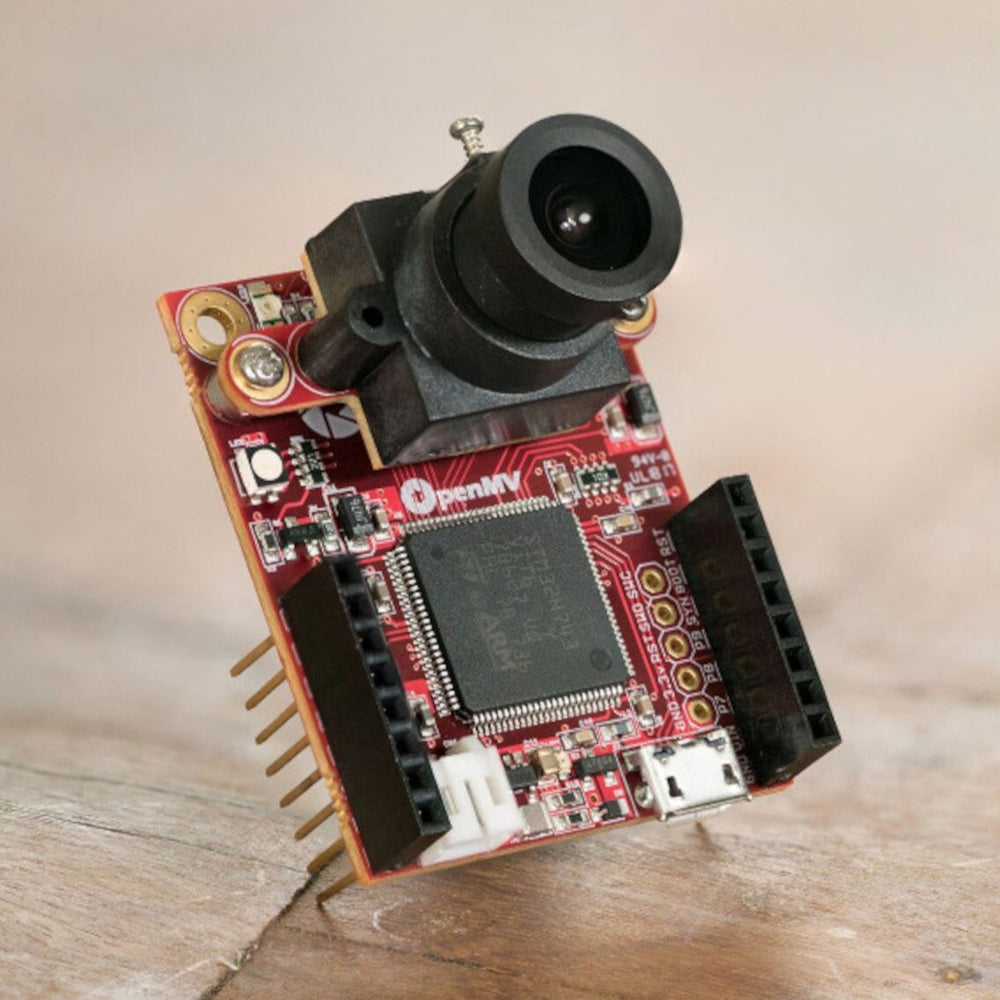
OpenMV Cam H7 R2 - High-performance machine vision camera with STM32H7 processor
Overview
The OpenMV Cam H7 R2 is a small, low power microcontroller board that allows easy implementation of machine vision applications in the real world. It runs high-level Python scripts using MicroPython, making it much easier to work with complex machine vision algorithms compared to traditional C/C++ programming.
Key Features
Processor
- STM32H743VI ARM Cortex-M7 running at 480 MHz
- 1MB SRAM and 2MB Flash memory
- Double Precision FPU for advanced calculations
- Core Mark Score: 2400 (comparable to Raspberry Pi 2: 2340)
Memory Layout
- 1MB Total RAM:
- 256KB for .DATA/.BSS/Heap/Stack
- 512KB Frame Buffer/Stack
- 256KB DMA Buffers
- 2MB Total Flash:
- 128KB Bootloader
- 128KB Embedded Flash Drive
- 1792KB Firmware
Camera System
- MT9M114 Image Sensor (included)
- 640x480 resolution at up to 80 FPS (lower resolutions)
- 40 FPS for resolutions above 320x240
- 2.1mm lens on standard M12 mount (replaceable)
- Removable camera module system with 8-bit parallel interface
Supported Image Formats
- Grayscale: 640x480 and under
- RGB565: 320x240 and under
- JPEG: 640x480 and under (both Grayscale and RGB565)
- BAYER/YUV422 support
I/O Interfaces
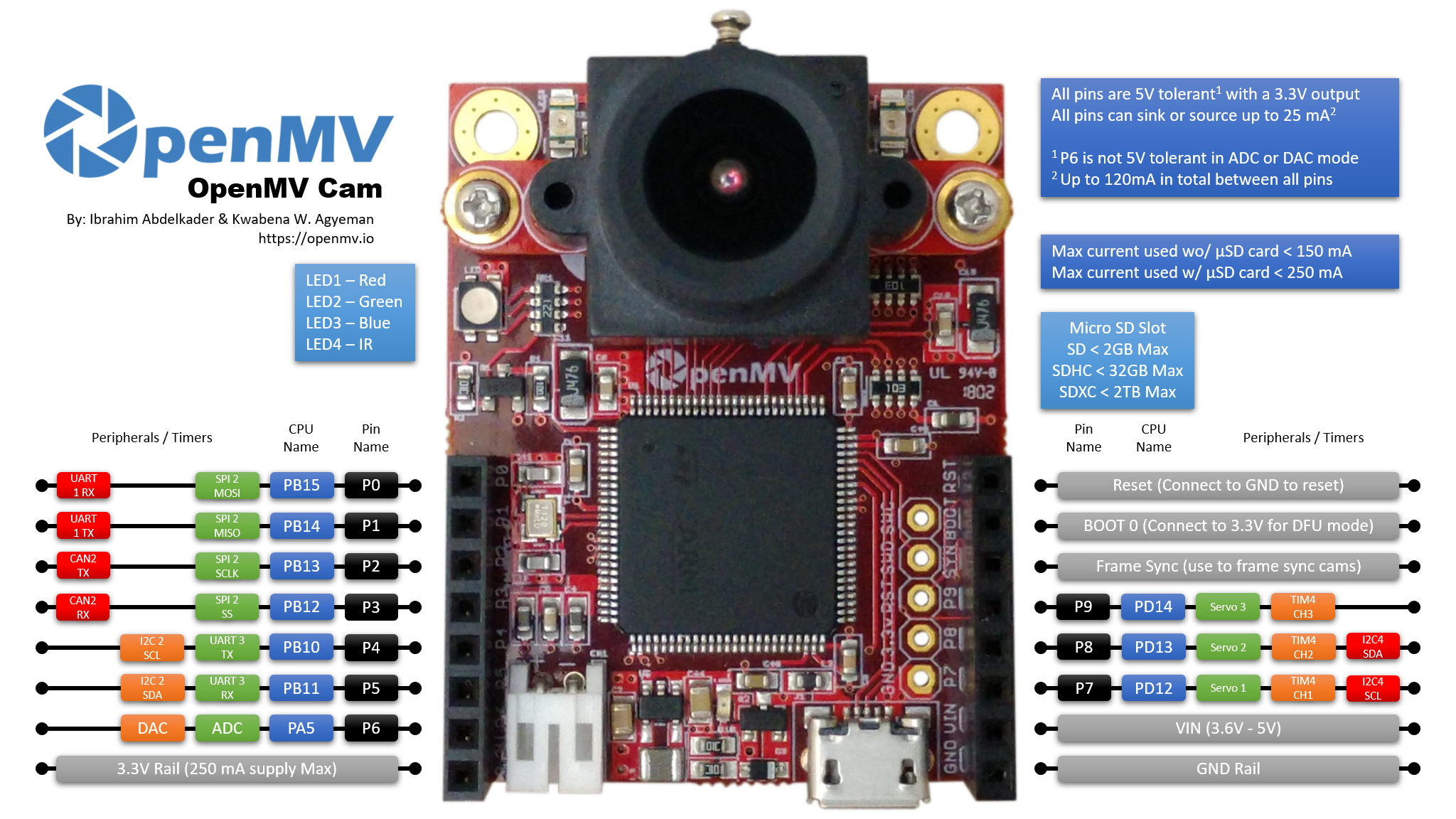
OpenMV Cam H7 R2 Pinout Diagram - All pins are 5V tolerant with 3.3V output
Communication
- Full Speed USB (12 Mbps) - appears as Virtual COM Port and USB Flash Drive
- μSD Card Socket - 100 Mbps read/write capability
- SPI Bus - up to 80 Mbps for image streaming
- I2C Bus - up to 1 Mb/s
- CAN Bus - up to 1 Mb/s
- Asynchronous Serial (TX/RX) - up to 7.5 Mb/s
Analog/Digital I/O
- 12-bit ADC and 12-bit DAC
- 10 I/O pins total (all 5V tolerant, 3.3V output)
- 3 servo control pins
- Interrupts and PWM on all I/O pins
- RGB LED and two high-power 850nm IR LEDs
Power Specifications
Power Consumption
- Idle (no μSD): 110mA @ 3.3V
- Idle (with μSD): 110mA @ 3.3V
- Active (no μSD): 160mA @ 3.3V
- Active (with μSD): 170mA @ 3.3V
Power Input
- VIN Range: 3.6V to 5V
- 3.3V Rail: Do not draw more than 250mA
- Pin Current: Up to 25mA per pin, 120mA total across all pins
- LiPo Battery Connector for 3.7V batteries
Physical Specifications
Dimensions
- Length: 45mm
- Width: 36mm
- Height: 30mm
- Weight: 16g
Operating Conditions
- Operating Temperature: -20°C to 70°C
- Storage Temperature: -40°C to 125°C
Lens Specifications
- Max Image Circle Diameter: 6.7mm
- Focal Length: 2.8mm
- Aperture: F2.0
- HFOV: 70.8°, VFOV: 55.6°
- Mount: M12×0.5 (standard, replaceable)
- IR Cut Filter: 650nm (removable)
- Format: 1/3”
Programming and Software
Development Environment
- MicroPython operating system
- OpenMV IDE for development
- High-level Python scripting instead of C/C++
- Open source software, firmware, and hardware
Machine Vision Capabilities
- Object detection and tracking
- Color detection and filtering
- Line following algorithms
- Face detection
- QR code and barcode reading
- Template matching
- Feature detection
Applications
Primary Use Cases
- Robotics: Vision-guided robots, line followers
- Industrial: Quality control, part inspection
- Security: Motion detection, object recognition
- Education: Computer vision learning projects
- IoT: Smart cameras, monitoring systems
- Automotive: Driver assistance prototypes
Expandability
- Compatible with various lens types via M12 mount
- Global Shutter Camera Module available separately
- FLIR Lepton Adapter Module for thermal imaging
- Various shields available (LCD, WiFi, etc.)
Technical Notes
Performance
- Most algorithms run at 40-80 FPS on QVGA (320x240) resolution
- Optimized for real-time machine vision processing
- Hardware acceleration for common vision tasks
Connectivity Options
- Direct connection to Arduino via special cable
- USB connection to Raspberry Pi
- Multiple interface options (SPI, I2C, UART, USB)
- Simple communication protocols
Storage Information
- Location: Cabinet 3, Bin 27
- Quantity: 1 unit
- Condition: New, unused
- Packaging: Original retail packaging with cables
- Documentation: Includes quick start guide and online resources