Important NoteThis entire repo was AI created - including all of the data within. The intent was to A) help me with my personal electronics inventory; and B) see how I could use AI to make that process a bit easier. DO NOT TRUST!
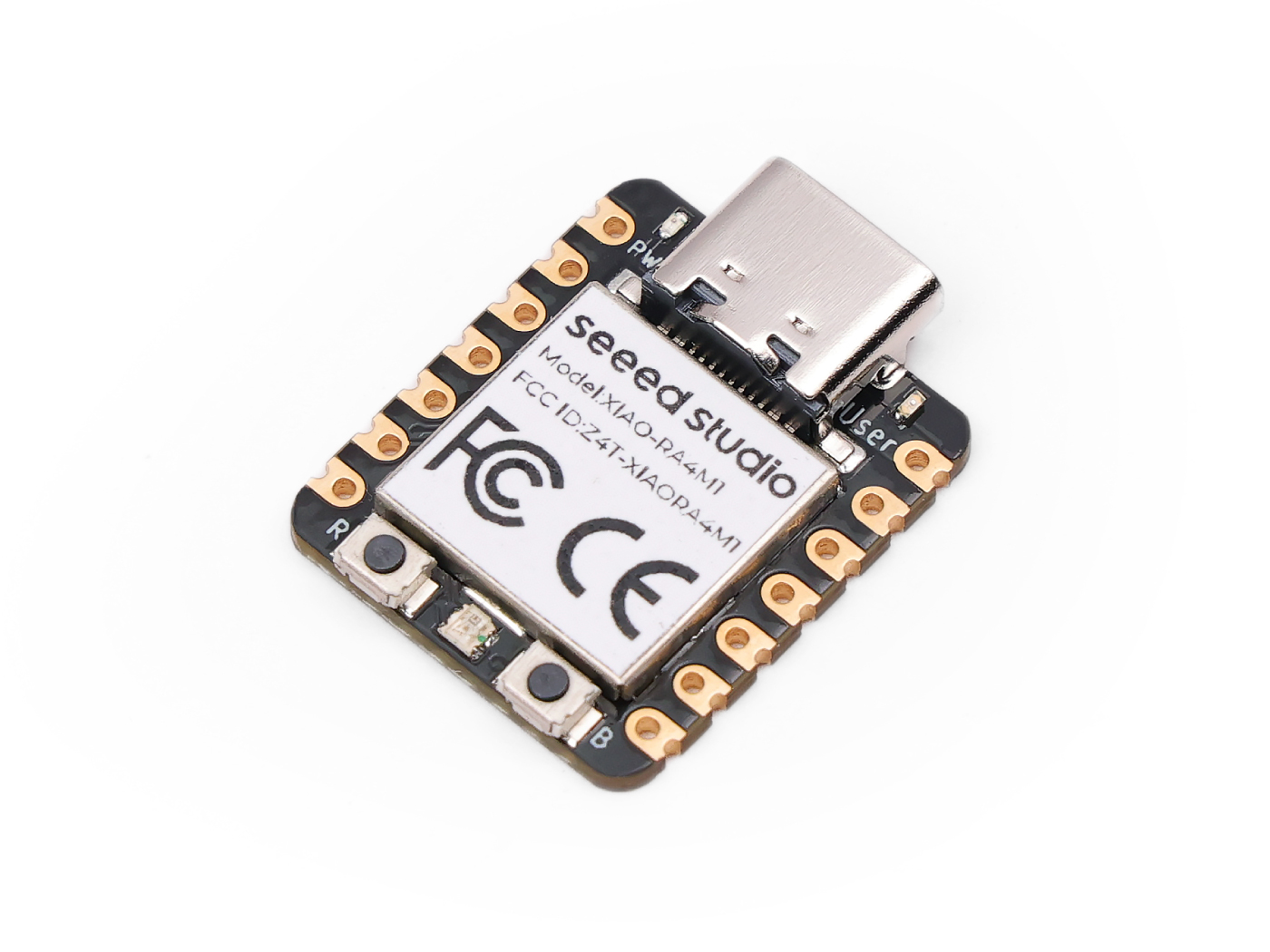
Seeed Studio XIAO RA4M1
Details
- Location: Cabinet-1, Bin 28
- Category: Microcontroller Boards
- Type: ARM Cortex-M4 Development Board
- Microcontroller: Renesas RA4M1 (R7FA4M1AB3CNE)
- Brand: Seeed Technology Co., Ltd
- Part Number: 102010551
- Quantity: 2
- Product URL: https://www.seeedstudio.com/Seeed-XIAO-RA4M1-p-5943.html
- Wiki: https://wiki.seeedstudio.com/getting_started_xiao_ra4m1/
Description
Thumb-sized ARM Cortex-M4 development board featuring the Renesas RA4M1 microcontroller — the same 32-bit MCU used in the Arduino Uno R4. Packed into the classic XIAO form factor, it offers a 14-bit ADC, 12-bit DAC, CAN BUS, hardware AES encryption, onboard LiPo charging, and 19 GPIO pins (including 8 rear pads). An excellent choice for battery-powered IoT nodes, automotive peripherals, and projects requiring the XIAO ecosystem of shields and accessories.
Image
Specifications
- Part Number: 102010551
- Microcontroller: Renesas RA4M1 (R7FA4M1AB3CNE)
- Architecture: 32-bit ARM Cortex-M4 with FPU
- Clock Speed: 48MHz
- Operating Voltage: 3.3V
- Input Voltage: 5V (via USB-C) or 3.3V
- Flash Memory: 256KB
- SRAM: 32KB
- EEPROM: 8KB
- Dimensions: 21.0mm x 17.8mm
- Working Temperature: -20°C to 70°C
Features
- ARM Cortex-M4 with FPU: Powerful 32-bit processor with hardware floating-point
- Arduino Uno R4 Compatible: Shares the same RA4M1 MCU as the Arduino Uno R4
- USB-C Connector: Modern connector for programming and power
- CAN BUS: Hardware CAN bus interface for automotive and industrial applications
- Hardware Encryption: AES-128/256 hardware acceleration
- 14-bit ADC: High-resolution analog input
- 12-bit DAC: True analog output
- Onboard LiPo Charging: Built-in lithium battery charge management
- Ultra Low Power: 45μA deep sleep current
- RGB LED: Onboard RGB LED plus user and power LEDs
Pin Configuration
- Total GPIO: 19 pins (11 standard + 8 rear pads)
- Digital I/O: 19 pins
- Analog Inputs: 6 pins (14-bit resolution)
- Analog Output (DAC): D0 / P014 (12-bit resolution) — not shown on official pinout diagram
- PWM: All digital pins support PWM
- I2C: 2 channels
- SPI: 2 channels
- UART: 2 channels
- CAN BUS: 1 channel
Power Specifications
- Operating Voltage: 3.3V
- Input Voltage: 5V (USB-C) or 3.3V (VCC)
- Current Consumption:
- Typical: ~42.6μA
- Deep Sleep: ~45μA minimum
- Battery: Onboard LiPo charge management circuit
- Power Management: Multiple sleep modes available
Connectivity
USB
- Type: USB-C connector
- Speed: Full-speed USB 2.0
- Functions: Programming, power, serial communication
CAN BUS
- Standard: CAN 2.0A/B compatible
- Use Cases: Automotive, industrial, multi-node networks
Applications
- Battery-powered IoT sensor nodes
- Wearable devices
- Automotive peripherals (CAN BUS)
- Arduino Uno R4 compatible projects
- High-precision analog data acquisition
- Audio/signal processing (FPU + DAC)
- Interactive art projects
- Embedded systems prototyping
Programming
- Arduino IDE: Full support (same MCU as Arduino Uno R4)
- MicroPython: Compatible with MicroPython
- PlatformIO: Cross-platform development support
XIAO Ecosystem
- Form Factor: Compatible with all XIAO accessories and shields
- Expansion Boards: Grove Base, Expansion Board
- Shields: Various XIAO-compatible shields
- Community: Large XIAO developer community
Notes
- Same RA4M1 MCU as the Arduino Uno R4 — existing Uno R4 libraries are often compatible
- 8 additional GPIO pads on the rear for more complex layouts
- Hardware AES encryption makes it suitable for secure IoT applications
- CAN BUS support is rare at this price point and form factor
- Onboard LiPo charging simplifies battery-powered designs
Tags
microcontroller, arm, cortex-m4, ra4m1, renesas, usb, xiao, seeed, arduino, can-bus, fpu