Important NoteThis entire repo was AI created - including all of the data within. The intent was to A) help me with my personal electronics inventory; and B) see how I could use AI to make that process a bit easier. DO NOT TRUST!
WEMOS ESP32-S2 Mini Development Board
Details
- Location: Cabinet-1, Bin 27
- Category: Microcontroller Boards
- Type: WiFi Development Board
- Microcontroller: ESP32-S2FN4R2
- Brand: WEMOS
- Model: S2 Mini
- Quantity: 9
- Product URL: https://www.aliexpress.com/item/1005003145192016.html
- Official Documentation: https://www.wemos.cc/en/latest/s2/s2_mini.html
- Schematic: https://www.wemos.cc/en/latest/_static/files/sch_s2_mini_v1.0.0.pdf
- Datasheet: https://www.espressif.com/sites/default/files/documentation/esp32-s2_datasheet_en.pdf
Description
Compact WiFi-enabled development board based on the ESP32-S2FN4R2 chip. Features native USB support, generous memory allocation, and compatibility with LOLIN D1 Mini shields. Perfect for IoT projects requiring WiFi connectivity with USB HID capabilities. Comes pre-loaded with MicroPython firmware.
Specifications
- Microcontroller: ESP32-S2FN4R2
- Architecture: Xtensa LX7 32-bit single-core
- Clock Speed: 240MHz
- Operating Voltage: 3.3V
- Flash Memory: 4MB
- PSRAM: 2MB
- Dimensions: 34.3mm x 25.4mm
- Weight: 2.4g
Images
Product Photos
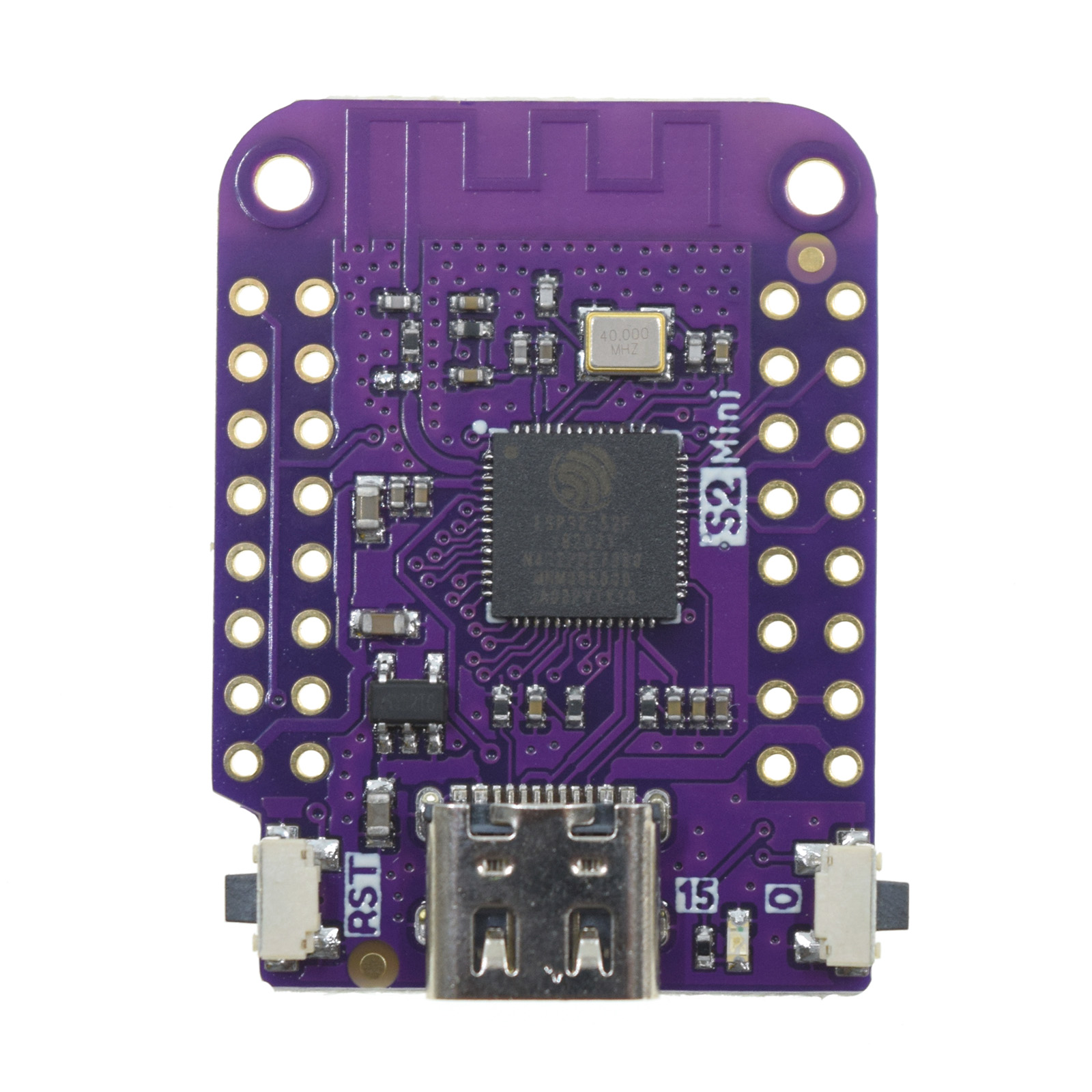
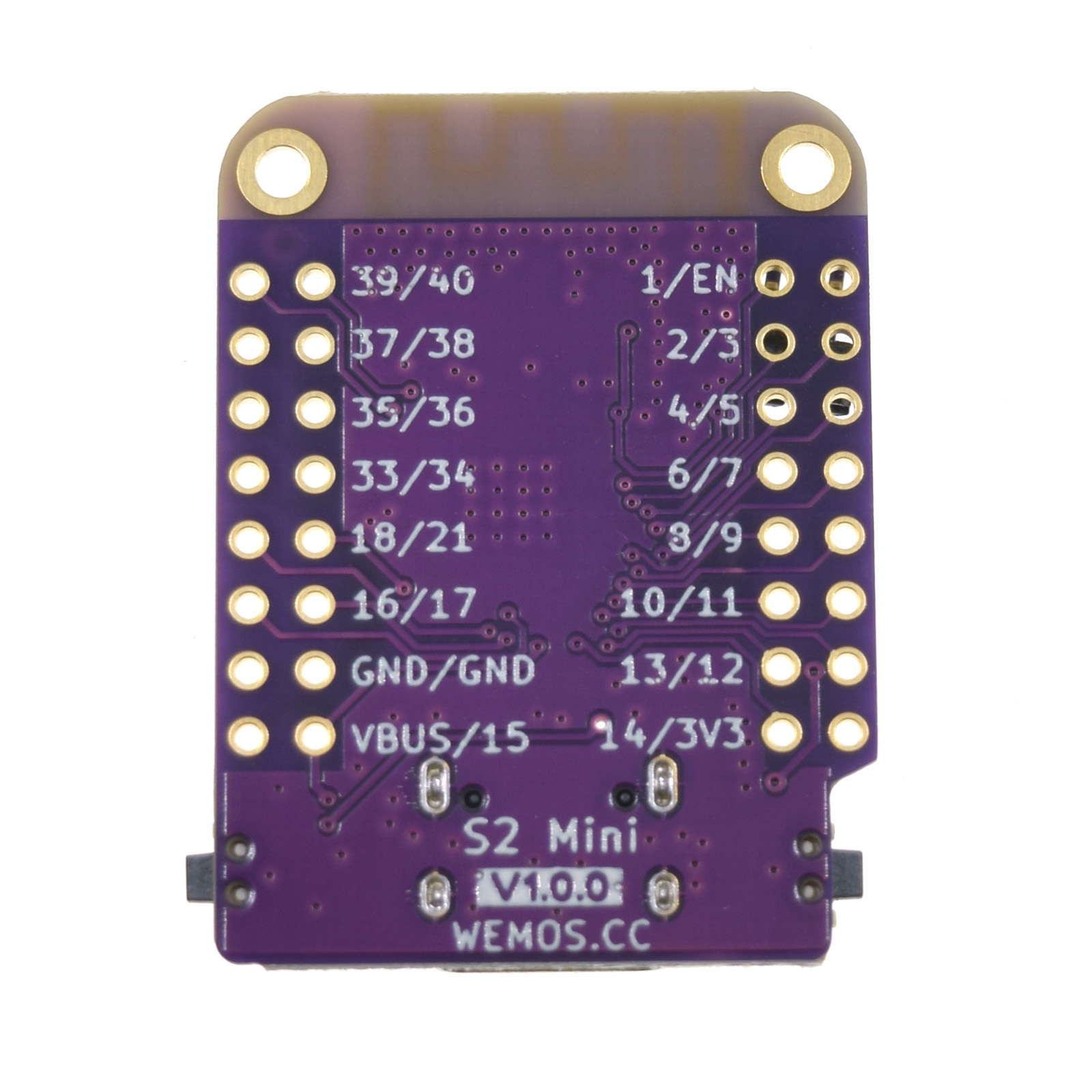
Pinout Diagrams
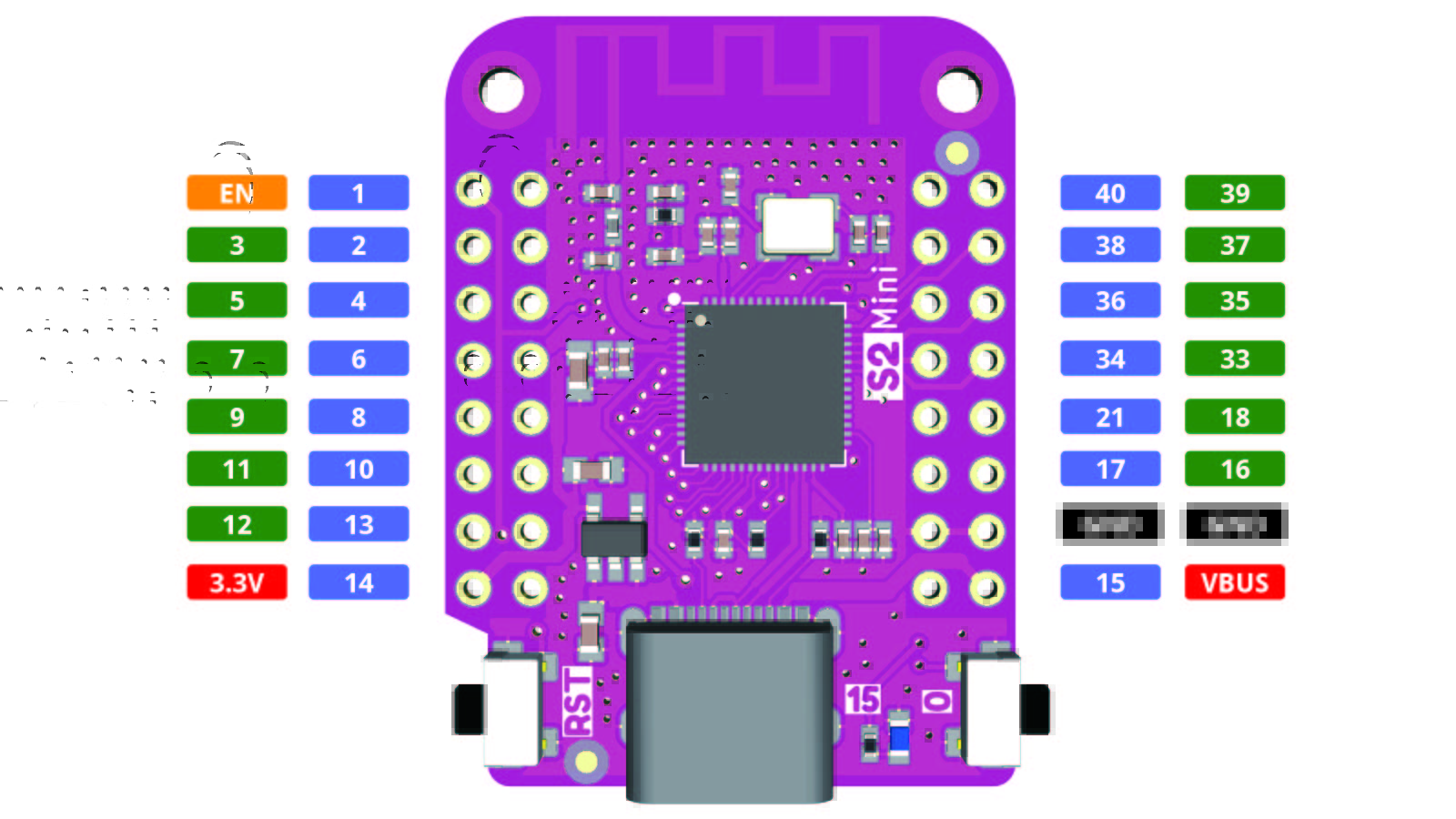
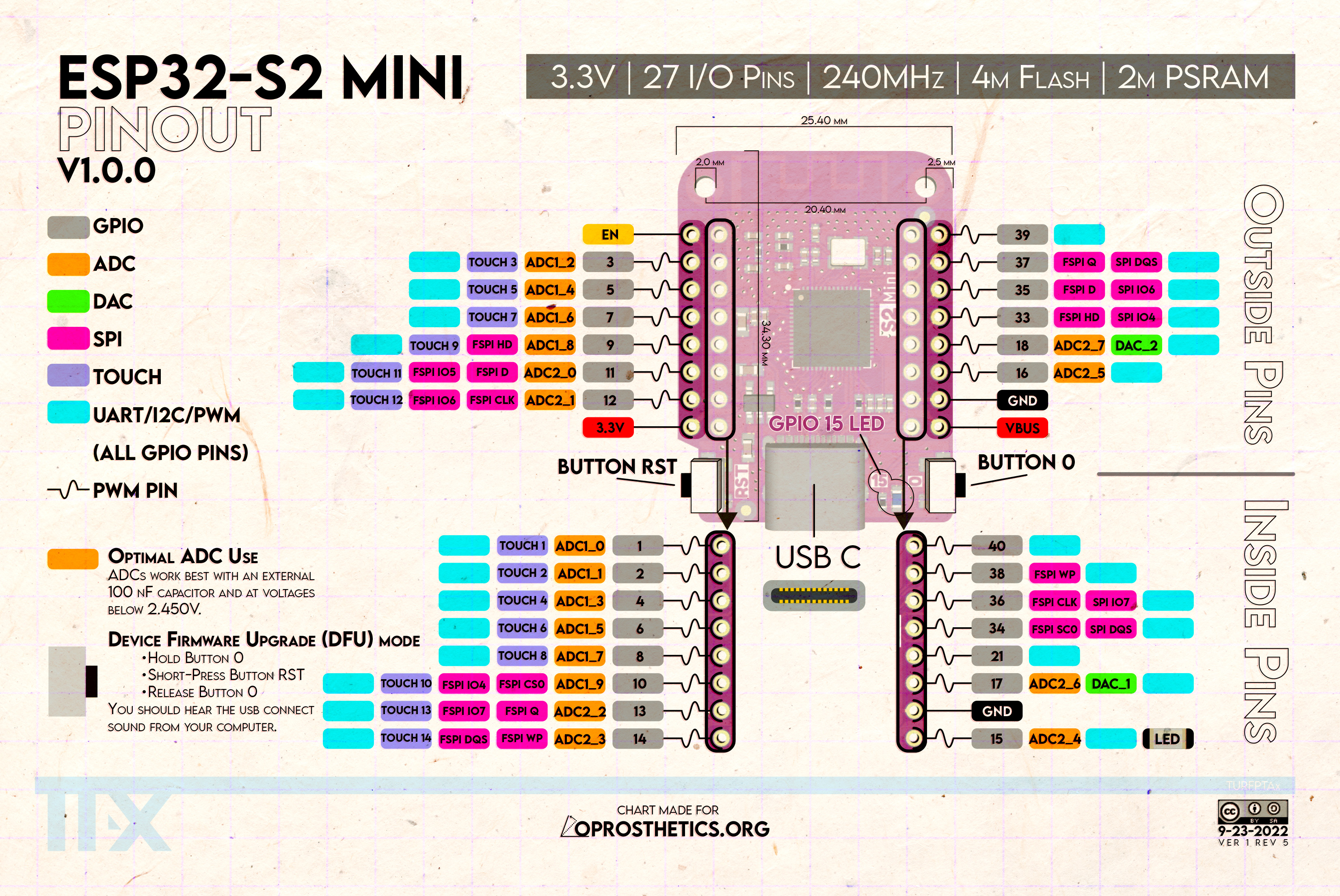
Features
- ESP32-S2FN4R2: Single-core WiFi microcontroller with native USB
- Native USB: Built-in USB support - can act as keyboard/mouse, MIDI device, mass storage
- Type-C USB: Modern connector for programming and power
- Rich Memory: 4MB Flash + 2MB PSRAM for complex applications
- 27 GPIO Pins: Extensive I/O capabilities
- D1 Mini Compatible: Works with existing LOLIN D1 Mini shields
- Multiple Programming: MicroPython, Arduino, CircuitPython, ESP-IDF support
- Default Firmware: Ships with MicroPython pre-installed
Pin Configuration
- Digital I/O: 27 GPIO pins
- Analog Inputs: 20 pins (12-bit ADC)
- Analog Outputs: 2 pins (8-bit DAC)
- PWM: All GPIO pins support PWM
- I2C: Hardware I2C support
- SPI: Hardware SPI support
- UART: Hardware UART support
- USB OTG: Native USB On-The-Go support
Detailed Pinout
Left Side (Top to Bottom)
- 3V3: 3.3V power output
- GND: Ground
- GPIO1: Digital I/O, ADC1_CH0, Touch1
- GPIO2: Digital I/O, ADC1_CH1, Touch2
- GPIO3: Digital I/O, ADC1_CH2, Touch3
- GPIO4: Digital I/O, ADC1_CH3, Touch4
- GPIO5: Digital I/O, ADC1_CH4, Touch5
- GPIO6: Digital I/O, ADC1_CH5, Touch6
- GPIO7: Digital I/O, ADC1_CH6, Touch7
- GPIO8: Digital I/O, ADC1_CH7, Touch8
- GPIO9: Digital I/O, ADC1_CH8, Touch9
- GPIO10: Digital I/O, ADC1_CH9, Touch10
- GPIO11: Digital I/O, ADC2_CH0, Touch11
- GPIO12: Digital I/O, ADC2_CH1, Touch12
- GPIO13: Digital I/O, ADC2_CH2, Touch13
- GPIO14: Digital I/O, ADC2_CH3, Touch14
Right Side (Top to Bottom)
- 5V: 5V power input (from USB)
- GND: Ground
- GPIO15: Digital I/O, ADC2_CH4, Touch15, XTAL_32K_P
- GPIO16: Digital I/O, ADC2_CH5, Touch16, XTAL_32K_N
- GPIO17: Digital I/O, ADC2_CH6, Touch17, DAC_1
- GPIO18: Digital I/O, ADC2_CH7, Touch18, DAC_2
- GPIO19: Digital I/O, ADC2_CH8, Touch19, USB_D-
- GPIO20: Digital I/O, ADC2_CH9, Touch20, USB_D+
- GPIO21: Digital I/O, RTC_GPIO0
- GPIO33: Digital I/O, XTAL_32K_P (if external crystal)
- GPIO34: Digital I/O, XTAL_32K_N (if external crystal)
- GPIO35: Digital I/O
- GPIO36: Digital I/O
- GPIO37: Digital I/O
- GPIO38: Digital I/O
- GPIO39: Digital I/O
- GPIO40: Digital I/O
- GPIO41: Digital I/O
- GPIO42: Digital I/O
Special Functions
- GPIO19/GPIO20: USB D-/D+ (native USB)
- GPIO17/GPIO18: DAC outputs (8-bit)
- GPIO1-GPIO14: Touch-sensitive pins
- All GPIO: PWM capable
- ADC1: GPIO1-GPIO10 (12-bit ADC)
- ADC2: GPIO11-GPIO20 (12-bit ADC, shared with WiFi)
Power Specifications
- Operating Voltage: 3.3V
- Input Voltage: 5V (USB-C) or 3.3V (VCC pin)
- Current Consumption:
- Active (WiFi): ~80-120mA
- Light Sleep: ~1-2mA
- Deep Sleep: ~10-20μA
- Power Supply: Built-in 3.3V regulator
Wireless Capabilities
WiFi
- Standards: 802.11 b/g/n (2.4GHz)
- Modes: Station, Access Point, Station+AP
- Security: WEP, WPA, WPA2, WPA3
- Range: Standard WiFi range
Applications
- IoT sensor nodes with WiFi connectivity
- USB HID devices (keyboard, mouse, MIDI)
- WiFi-enabled automation projects
- MicroPython learning and development
- CircuitPython projects
- Web servers and clients
- MQTT clients and IoT gateways
- Educational microcontroller projects
Programming
- MicroPython: Default firmware, drag-and-drop programming
- Arduino IDE: Full support with ESP32 board package
- CircuitPython: Native support with USB drive functionality
- ESP-IDF: Espressif development framework
- USB Programming: No external programmer needed
- Libraries: WiFi, HTTP, MQTT, USB HID libraries
Programming Examples
Arduino WiFi Example
#include <WiFi.h>

const char* ssid = "your-wifi-ssid";
const char* password = "your-wifi-password";

void setup() {
  Serial.begin(115200);
  WiFi.begin(ssid, password);

  while (WiFi.status() != WL_CONNECTED) {
    delay(1000);
    Serial.println("Connecting to WiFi...");
  }

  Serial.println("WiFi connected!");
  Serial.print("IP address: ");
  Serial.println(WiFi.localIP());
}

void loop() {
  // Your code here
}
MicroPython Example
import network
import time

# Connect to WiFi
wlan = network.WLAN(network.STA_IF)
wlan.active(True)
wlan.connect('your-wifi-ssid', 'your-wifi-password')

while not wlan.isconnected():
    print('Connecting to WiFi...')
    time.sleep(1)

print('WiFi connected!')
print('IP address:', wlan.ifconfig()[0])
USB HID Example (Arduino)
#include "USB.h"
#include "USBHIDKeyboard.h"

USBHIDKeyboard Keyboard;

void setup() {
  Keyboard.begin();
  USB.begin();
}

void loop() {
  Keyboard.print("Hello from ESP32-S2!");
  delay(5000);
}
D1 Mini Ecosystem
- Shield Compatible: Works with LOLIN D1 Mini shields
- Form Factor: Standard D1 Mini pinout and dimensions
- Accessories: Large ecosystem of compatible shields and sensors
- Community: Extensive D1 Mini community support
Advantages
- Native USB: Advanced USB functionality built-in
- Rich Memory: 4MB Flash + 2MB PSRAM for complex projects
- Shield Compatible: Leverage existing D1 Mini ecosystem
- Multi-Language: Support for multiple programming environments
- Cost Effective: Excellent price-to-performance ratio
- Easy Development: MicroPython pre-installed for quick start
Hardware Features
- Type-C USB: Modern, reversible connector
- Reset Button: Convenient program restart
- Boot Button: Enter bootloader mode
- User LED: Built-in status indicator
- Antenna: PCB antenna for WiFi connectivity
Comparison with Other ESP32-S2 Boards
- vs Adafruit QT Py ESP32-S2: Larger size but more GPIO pins and shield compatibility
- vs ESP32-S2-DevKitC: More compact, shield-compatible form factor
- vs ESP32-S3: Single-core vs dual-core, no Bluetooth but native USB
Notes
- Single-core ESP32-S2 (not dual-core like ESP32 classic)
- No Bluetooth support (WiFi only)
- Native USB enables advanced interfacing capabilities
- 4MB Flash + 2MB PSRAM allows for complex applications
- Perfect for IoT projects requiring WiFi connectivity
- D1 Mini shield compatibility expands functionality
- MicroPython firmware makes it beginner-friendly
- Excellent for learning ESP32-S2 architecture
Default Firmware
- MicroPython: Pre-installed for immediate use
- REPL Access: Interactive Python shell via USB
- File System: Access files via USB mass storage
- WiFi Libraries: Built-in WiFi connectivity support
Tags
microcontroller, esp32-s2, wifi, wemos, s2-mini, usb-c, d1-mini-compatible, iot, micropython, circuitpython